
Frequently Asked Questions
Quick answers
We tried to cover most things in the manuals, but there are always more questions. We've gathered some of the common questions and answers below. If you more, please don't hesitate to contact us.
Using SPOT
Why do we have channel numbers and tag numbers?
For each animal we want to track, we mostly care about its name and the frequency of it's transmitter. This is kind of like a radio station; e.g. KRML is on frequency 94.7 MHz. If we want to save that radio station and a bunch of others into our car radio, we might put in KRML first, then KAZU (90.3), then KZSC (88.1), and so on. In our radio, KRML would be channel 1, KAZU would be 2, and KZSC would be 3. Channel numbers are just where we happen to put things into memory. You can think of a channel as a memory slot.
The problem is that if we've got 100+ animals we're keeping track of, it's tough to remember which animal is in which memory slot. However, often animals have tag numbers that we get to know pretty well. If you start your names with a tag number, SPOT will let you jump directly to it - you don't need to know what channel it is. that's Tag Mode.
Can I get to a specific channel/tag even if it's not in my active lists?
Yes. Let's say you're in a list with just five members and you temporarily want to listen for a different channel/tag. Just enter the channel/tag number and SPOT will bring it up. However, that doesn't add it to the list - it's just brings it up temporarily. If you navigate away using ▲ / ▼ or with a scan, you won't see it again.
Of course, you can add it to a list using the normal menu item, but if you just want to check the channel temporarily, you don't have to do that.
Can I create a new list on-the-fly?
Yes. The standard way is to use the menu item to give an unused list (e.g. L15) a new name, then add members with repeated use of the menu item.
There is a simpler/faster way to do this using Ad Hoc lists. Check out the details in the manual.
What if I have a new feature request?
Let us know about it, but we can't promise if or when it will be implemented.
If found a bug! What do I do?
Please inform us know about it. We'll put it on our list and let you know if there is a workaround.
Programming the Receiver
Can I program the receiver using on-device menus only?
You can, but I wouldn't. If you have more than a handful of channels (tags) that you want to program into SPOT, it becomes a very laborious process - particularly entering names. You will be much better off using SPOT Tools to program your unit.
I keep my tag information in a spreadsheet. Can I use that?
Yes. SPOT Tools can read a spreadsheet with channel information, list information, and even receiver settings, and send that to the device. You'll need to copy and paste information from your spreadsheet into the format that SPOT Tools expects. More information on the details can be found here.
Can I export from my database into a file that SPOT Tools can read?
Probably. SPOT Tools has it's own JSON format which you can read about here. It's fairly straightforward so producing it from information in a database should not be difficult. The app also reads Excel files which you may prefer.
Will you help me program my receiver?
We can help you get over hurdles you may have. Please contact us with questions.
Using SPOT Tools
Can I "clone" one receiver to another?
Yes, in two steps. Connect the receiver you want to clone to your computer as usual and press the "Read From Receiver" button. That will copy all the settings, channels, and lists to your computer. Disconnect the first receiver, connect the second, and then "Write To Receiver". The second is now a clone of the first.
What if I have a new feature request?
Let us know about it, but we can't promise if or when it will be implemented.
If found a bug! What do I do?
Please inform us know about it. We'll put it on our list and let you know if there is a workaround.
Receiver Hardware
Is my receiver a 2MB model?
At this point in time there is no way that we know of to determine whether a particular unit is a 2MB model other than the vendor's listing for the radio. All of the units we know of that are v3 models have 2MB of storage, but that is certainly no guarantee.
When SPOT has been flashed onto the device, you can look at the menu item and there will be a page labeled SPI Flash. It will list the numbers: "85 20 15" for a 2MB unit.
Can I buy a receiver from you?
We don't sell or distribute the hardware. Sorry.
What kind of antenna connector does the receiver have?
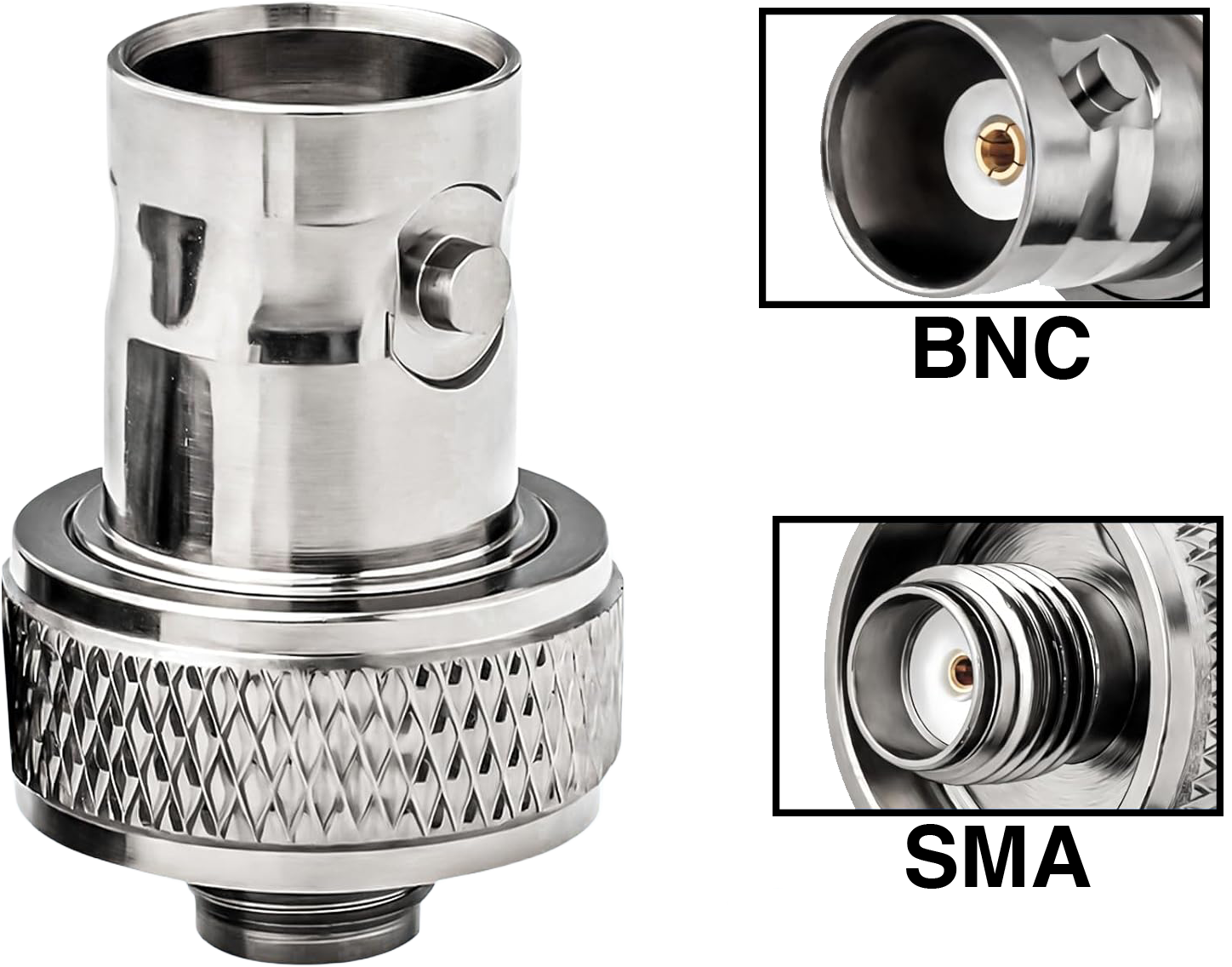 The body of the receiver has a male SMA connector. You'll need an adapter for use with a BNC connector. The image to the right shows the type of adapter you'll need (click for a larger view).
The SPOT manual shows it attached to a receiver.
The body of the receiver has a male SMA connector. You'll need an adapter for use with a BNC connector. The image to the right shows the type of adapter you'll need (click for a larger view).
The SPOT manual shows it attached to a receiver.
Can I "brick" my receiver with this firmware?
Yes! Dealing with low level firmware on devices like this can result in the receiver becoming inoperable. If you flash new firmware onto the unit, you do so at your own risk. Please see our disclaimer.
General
How much does SPOT cost?
SPOT and SPOT Tools are free, but you'll need to source the hardware (the physical receiver). As of 2026-06, these can be had for about $30.
I want to contribute to SPOT. How can I help?
Testing is our biggest need right now, along with review of the documentation. Please let us know about issues in SPOT Tools, SPOT, the manuals, or the site.
We aren't quite ready yet to take software contributions, but that is coming.
How do I generate programming files compatible with SPOT Tools?
Please take a look at our JSON File Specification and our Excel File Specification. You can also save files from SPOT Tools to get as many examples as you'd like.
What does SPOT stand for?
SPOT is meant to evoke the idea of spotting wildlife, and it's also an acronym for Simple, Portable, Open Telemetry.
SPOT costs over 20x less than other receivers. What did you give up?
You're right, there's no free lunch. First, SPOT is a community project and therefore is not supported by a vendor. If you have a problem, you'll need to depend on the hardware vendor for receiver issues, or the SPOT community for software issues.
At a more technical level, the hardware that SPOT runs on was not designed for telemetry use. The firmware coerces it to act like a telemetry receiver, but if you were designing the hardware from scratch, you'd use components that were better suited to the sort of narrow-band pulsed carrier signals that we're trying to detect.
I've got a question that isn't covered here.
No problem, just reach out to us and we'll do our best to answer.